
A 0.1 BTC Target Takes Years, So Plan the Math First
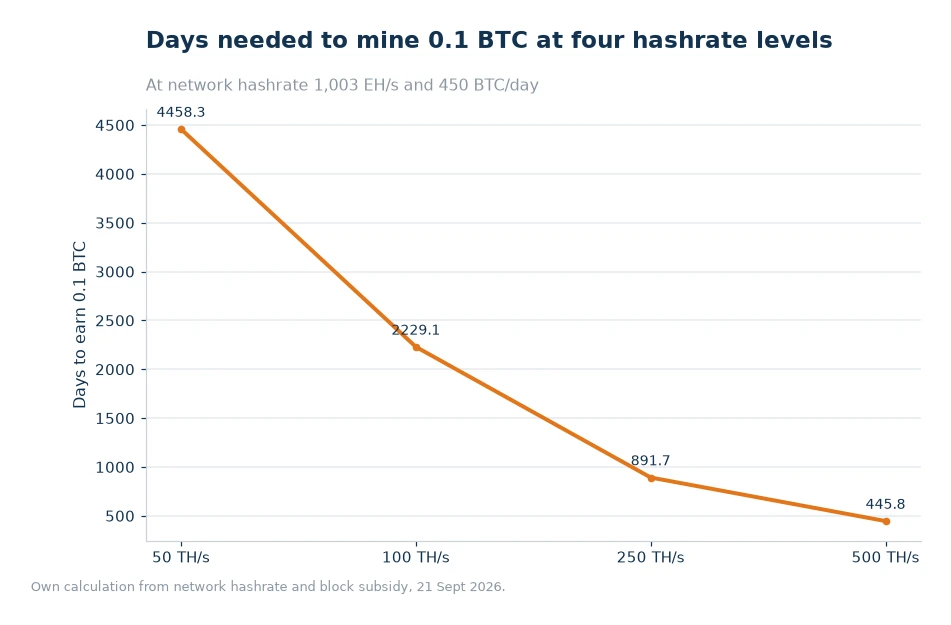
A tenth of a bitcoin sounds like a milestone. At 50 TH/s it is a twelve-year project: 4,458.3 days at a network hashrate of 1,003 EH/s. At 500 TH/s the same target takes 445.8 days, which is one year and change. The ratio between those two rows is ten, exactly as the ratio of hashrate. What follows is the arithmetic, the two pool readings that complicate it, and the reason the difference between twelve years and one year is a hardware decision rather than a pool decision.

Key takeaways
- 50 TH/s needs 4,458.3 days for 0.1 BTC; 500 TH/s needs 445.8 days at the same network hashrate.
- Daily output at 50 TH/s is 0.00002243 BTC, about $1.90 gross at $84,692 per BTC.
- Pool hashrate decides how often blocks arrive; Pool Luck measures how far a window drifts from expectation.
- Difficulty moves the target date, so recompute whenever the estimate changes rather than trusting a stored number.
Twelve years is a statement about hardware, not patience
The number that matters here is not 0.1 BTC. It is the daily rate that divides into it. At 50 TH/s the rate is 0.00002243 BTC a day, and dividing 0.1 by that produces 4,458.3 days. Nothing in the arithmetic is exotic; it is one division. But a result measured in years should change how a miner reads every other figure in the plan, because hardware rarely runs unchanged for twelve years and difficulty certainly does not.
Read the same target at 500 TH/s and the result is 445.8 days, still over a year but within the service life of a modern machine. At 250 TH/s it is 891.7 days, and at 100 TH/s it is 2,229.1. The spread between the smallest and largest row is a factor of ten, which is also the spread in capital cost for the hardware that produces it. A target-based plan is really a hardware-sized plan wearing a coin-denominated label.
Three inputs, one of which you control
Daily output depends on your hashrate, the network hashrate and the block subsidy, with price playing no part in the coin count at all. Price only decides what the coins are worth when they arrive. Of those three inputs, the subsidy is fixed at 3.125 BTC per block until the next halving, the network hashrate is set by everyone else, and your hashrate is the only lever you own. That is why every honest answer to "how long will this take" starts with a number you choose and ends with a number nobody can promise.
Difficulty then acts on the network side. The next estimate on the read date was −2.12%, a small easing. If it lands, a 4,458.3-day figure becomes about 4,364 days and a 445.8-day figure becomes about 436. Directionally helpful, arithmetically modest. The larger point is that the estimate changes every 2,016 blocks, so the target date is a function of a variable, not a date on a calendar.
What the pool's numbers add
The ViaBTC BTC Mining Pool state view carries the readings that miners check before committing hardware: the pool's hashrate, its share of the network, and a luck figure for recent blocks. Pool Hashrate matters for cadence. A pool with a larger share finds blocks more often, so PPLNS settlements arrive in smaller, more frequent pieces, and the variance a miner carries per settlement falls.
Pool Luck compares blocks found with blocks expected over the same window. Above 100% the pool found more than its share implied; below 100% it found fewer. Neither reading is a quality signal. Block discovery is random, and windows of a few hundred blocks scatter widely around the mean by design. What the reading does tell you is how much of a PPLNS month was luck rather than hashrate, which is exactly the question a miner asks after a disappointing settlement. PPS+ miners can ignore it for income purposes, because hourly settlement runs against difficulty rather than against blocks found.
The schedule at four sizes
The table converts the daily rate into days and years, so the scale of the commitment is visible without a second calculation. The monthly column is the figure most operators actually track, since it lines up with a power bill.
| Hashrate | Daily BTC | Days to 0.1 BTC | Years |
|---|---|---|---|
| 50 TH/s | 0.00002243 | 4,458.3 | 12.2 |
| 100 TH/s | 0.00004487 | 2,229.1 | 6.1 |
| 250 TH/s | 0.00011215 | 891.7 | 2.4 |
| 500 TH/s | 0.00022433 | 445.8 | 1.2 |
The years column uses 365 days and ignores leap years, which changes nothing at this precision. It also ignores difficulty drift, hardware failure and downtime, all of which push the date later rather than earlier. Treat the numbers as a floor for a machine that runs continuously at a fixed difficulty, and then ask how much of that uptime you can honestly promise.
Worked example
Take 50 TH/s and build the answer from the subsidy upward, then check the fastest row the same way.
- Network daily issuance: 3.125 BTC × 144 blocks = 450 BTC.
- Share of network: 50 ÷ 1,003,000,000 = 0.00000004985.
- Daily coins: 0.00000004985 × 450 = 0.00002243 BTC.
- Days to target: 0.1 ÷ 0.00002243 = 4,458.3 days, or 12.2 years at 365 days a year.
- At 100 TH/s, double: 0.00004487 BTC a day, 2,229.1 days, 6.1 years.
- At 250 TH/s, five times: 0.00011215 BTC a day, 891.7 days, 2.4 years.
- At 500 TH/s, ten times: 0.00022433 BTC a day, 445.8 days, 1.2 years.
- Value: 0.1 BTC at $84,692 is $8,469.20 gross, or $8,130.43 after the listed 4% on the block-reward component.
Where the years go
Electricity is the cost that accumulates over those years, and it accumulates whether or not the target is met. A 50 TH/s machine drawing 1.5 kW at six cents a kilowatt-hour costs about $65.70 a month, or roughly $2.16 a day, against $1.90 of gross daily output at $84,692 per BTC. That comparison alone explains why small targets over long horizons are usually a poor use of a machine, independent of which pool processes the shares.
A 500 TH/s machine at 5 kW costs about $219 a month and produces roughly $19.00 a day gross, or $570 a month, which leaves room after power. The arithmetic is not a recommendation; it is the reason the years column and the power column belong side by side. Both are arithmetic on the same inputs, and both change when the BTC price or the difficulty estimate moves.
Frequently asked questions
Why does 50 TH/s take more than twelve years for 0.1 BTC?
Because 50 TH/s is 0.000004985% of a 1,003 EH/s network and therefore earns 0.00002243 BTC a day, and 0.1 divided by that daily rate is 4,458.3 days.
Does a lucky pool shorten a multi-year target?
Only for PPLNS miners in the short run; across years the luck reading converges toward the expected share, and PPS+ income is not affected by it at all.
Should I pick a pool by its Pool Hashrate?
Use it to understand settlement cadence and variance rather than expected income; a larger pool finds blocks more often, but your share of the network is what sets the daily coin count.
Size the hardware to the horizon you can defend
Choose the horizon first, then read the hashrate it requires off the table, and only then look at machines. A one-year target needs something near 500 TH/s at current conditions; a twelve-year target needs 50 TH/s and a great deal of optimism about uptime. The ViaBTC miner ranking lists current model economics against price and difficulty, which turns the horizon into a shortlist. Revisit it after each difficulty adjustment, and the plan stays a plan rather than a hope.
Sources: the pool state page for Pool Hashrate and Pool Luck[1], and chain figures read 21 Sept 2026 — network hashrate 1,003 EH/s, difficulty 132.76 T, 3.125 BTC per block, 144 blocks a day, BTC $84,692 — published 22 Oct 2026. Power examples assume stated draw and a stated tariff; all day counts are arithmetic on the inputs above.